
Crispy Leaf Edges After a High-pH Watering: Burn, Not Bug
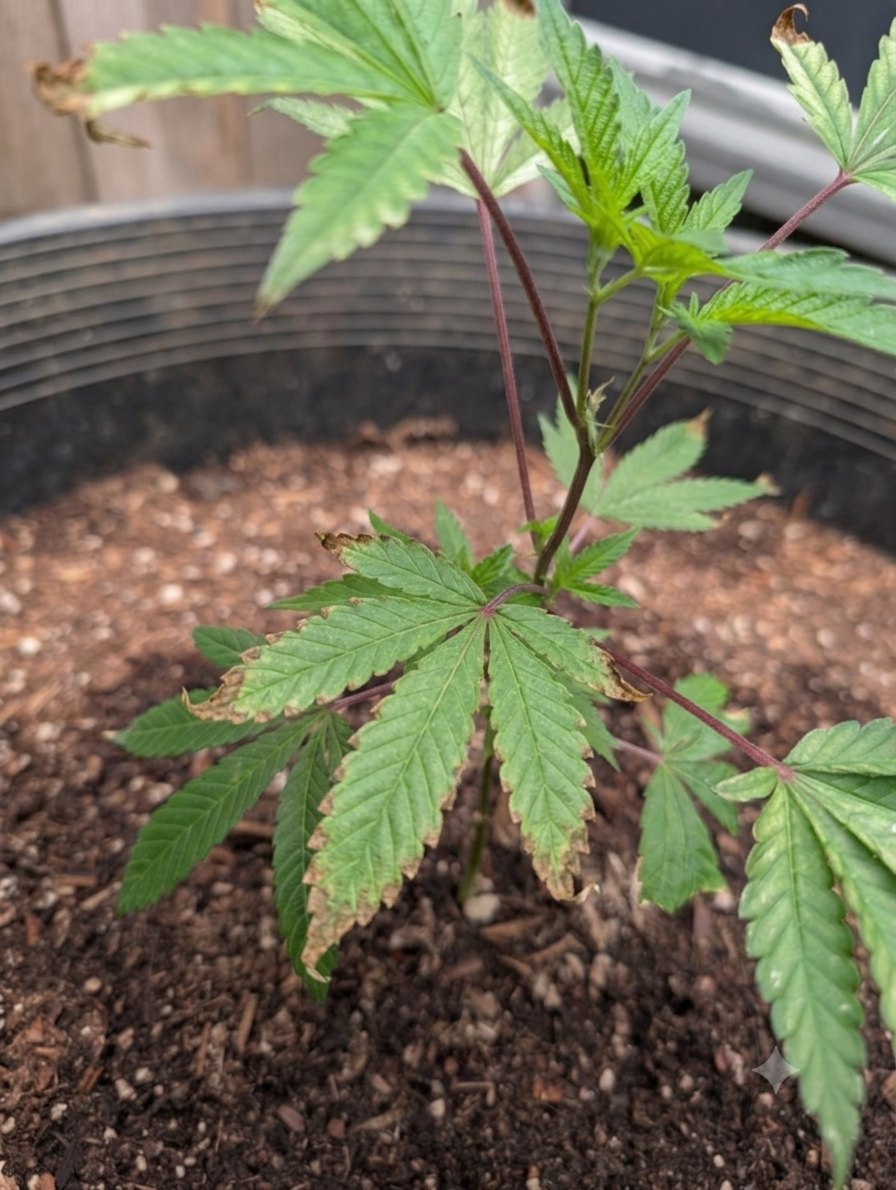
The situation
A grower checked on their outdoor photoperiod Bruce Banner in a 30-gallon fabric pot of Fox Farm Ocean Forest, still in vegetative stage. The morning was cool and damp — 56°F, 91% RH, partly cloudy — nothing extreme, but the plant looked noticeably worse than the day before.
The damage was specific: dry, crispy tan-brown margins creeping in from the tips and edges of the larger, older fan leaves. The newest growth up top was still clean green and healthy. Turgor was fine, unburned tissue held a solid medium green, and stem color hadn't changed. Soil surface was dark and moist — no crust, no pooling.
The one thing that had changed recently was the last watering, roughly 48 hours earlier, done with water the grower suspected was high pH.
The diagnosis
Edge and tip burn on older, already-expanded leaves is the classic signature of chemical or osmotic burn. Salts and mineral load concentrate where the plant transpires hardest — the leaf tips and margins — and the damage marches inward from there. Because those older leaves were fully open when the stress hit, they took the hit. New growth up top came in after, clean.
That pattern also rules out a lot. An immobile-nutrient deficiency like calcium, iron, sulfur, or boron would show up on the new growth first, not the old. Light bleaching would hit the top of the canopy, not the middle fan leaves — and outdoor light hadn't spiked. Powdery mildew is dry white fuzz, not dry brown necrosis, so that's out too.
The trigger was the high-pH watering into Fox Farm Ocean Forest — a soil that already carries a heavy nutrient charge in early veg. A pH swing on a hot soil stalls Ca/Mg uptake and pushes soluble salts around the root zone. The plant expressed it exactly where you'd expect.
The solution
- At the next watering, do a proper pH-corrected flush: plain water at pH 6.5 (target range 6.3-6.8), roughly 1.5-2x the pot volume, poured slowly until you get real runoff.
- Catch a runoff sample and test both pH and EC. That tells you where the root zone actually sits, not where you hope it sits.
- Do NOT feed nutrients for at least the next 10-14 days. FFOF still has plenty of charge — adding more right now makes the burn worse, not better.
- Grab a cheap pH pen (~$15) and pH test strips today if you don't already have them. Watering blind is exactly how this happened.
- Trim off the fully crispy leaf tips only if they're bothering you — leave partially damaged leaves alone, they're still photosynthesizing.
- Re-check in 48-72 hours. New growth should keep coming in clean. If fresh top growth starts showing damage, that's a new problem and worth another look.
How to avoid this
- Always pH your water before it hits the pot. For soil, aim 6.3-6.8. It takes 30 seconds and prevents 90% of "mystery burn" cases.
- Know your soil. Hot pre-amended mixes like Fox Farm Ocean Forest do NOT need added nutrients for the first 3-4 weeks in a large pot. Restraint beats reflex feeding.
- Test your water source. Tap, well, and rain water all sit at different pH and EC — assume nothing until you've measured.
- Water slowly and evenly around the pot, not in one spot. Uneven watering creates salt pockets that burn roots locally.
- Log every watering: date, volume, pH in, runoff pH/EC if you have it. When something goes sideways, the log tells you what changed.
Facing something similar? Start a free journal and I'll look at your plant — photos in, diagnosis out, 24/7.
Get a free diagnosis